Blog · Content Economy
The REAL Currency of the AI Economy
What will determine whether the AI economy thrives or collapses?

Not compute. Not capital. Not even talent.
In one word: Trust.
If LLMs are going to live up to the expectations and the hype, we need to be able to trust them. And right now, we can’t.
From Librarians to Teachers
Consider the shift that’s happened beneath our feet.
In the Internet of Search, humans did most of the cognitive work. Search engines functioned as librarians , essentially curating, organising, pointing us toward what we were looking for. You wouldn’t expect a librarian to explain a book to you. That was YOUR job.
In the Internet of Answers, the relationship has inverted. LLMs function as teachers, consultants, and assistants. They do considerable cognitive work on our behalf. We’re presented with fait accompli answers that are synthesised, summarised, ready to act upon.
This changes everything.
We no longer evaluate sources and triangulate perspectives. We receive conclusions. And conclusions we don’t trust are worthless, even dangerous.
The Knowledge Problem
This shift raises deep philosophical questions we’ve barely begun to grapple with.
We want the LLM to know, not just to list. But what does it mean for a machine to “know” something? What constitutes authority? How do we assess expertise when we can’t see the reasoning? How do we detect bias when the output appears seamlessly confident?
These aren’t just academic questions. They’re existential ones for the AI economy.
We’re living in an age where information warfare is ubiquitous. Disinformation spreads like wildfire, accelerated by social media algorithms that optimise for engagement over accuracy and outrage over truth. The epistemological ground beneath us has never been less stable.
And into this environment, we’re introducing systems that speak with the confidence of experts while drawing from the open sewer of the internet.
Content is Infrastructure
I’ve argued before that content is infrastructure: not aesthetics. It’s just as critical to the success of the AI ecosystem as energy supply and processing power, perhaps even more.
But who’s monitoring the quality of what goes into these models? Who’s ensuring the knowledge they retrieve isn’t contaminated by epistemological toxic agents such as misinformation, disinformation, spam, and slop, all of which pollute the web?
The uncomfortable truth: garbage in, garbage out doesn’t disappear just because you scale to a trillion parameters. It gets laundered. It gets dressed up in fluent prose and confident assertions. It becomes harder to detect, not easier. More dangerous, insidious.
The Human Curation Imperative
I believe the answer lies in human-curated vertical knowledge networks.
Not because AI can’t process information, as we know it excels at that. But because the critical functions of verification, authority, and trust remain fundamentally human.
Here’s the architecture I see emerging:
1. Humans create content that reflects the human experience. Art. Original reporting. Expert analysis. Commentary. The irreplaceable work of people who actually know things, have done things, have tested things, have lived things. This is the raw material of knowledge, and no amount of synthetic data can substitute for it.
2. Humans curate that content and validate its expertise and authority. Editorial judgment. Source verification. Quality control. The unglamorous but essential work of separating signal from noise, expertise from opinion, fact from fabrication. This is the layer the current AI stack is missing entirely.
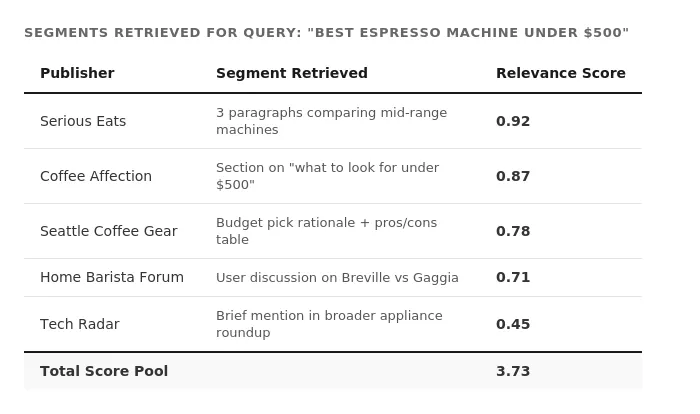
3. LLMs access these verified pools for cognitive outputs. Not the open web with all its pollutants. Not scraped data of unknown provenance. But curated, licensed, semantically-indexed knowledge from sources that have earned trust through editorial rigour.
The Economics of Trust
The beautiful thing about this model is that the economics align with the epistemology.
When AI platforms pay for access to verified content, and that payment flows to the humans who created and curated it, you create a sustainable ecosystem. Publishers are rewarded for maintaining standards. Quality content becomes economically viable. The race to the bottom reverses.
When everything is free and scraped, nobody invests in quality. When quality is compensated, the system regenerates.
Trust is the foundation on which the entire AI economy must be built.