Blog · Content Economy
The Combustion Engine Moment
How AI Restores Content to Its True Purpose
In the mid-1800s, petroleum refiners had a problem: the kerosene they produced was valuable for lighting and much cheaper than the common household alternative which was whale fat, but it came with a dangerous & volatile byproduct: gasoline! So for decades, refiners just dumped it into rivers or burned it off as waste.
But then came the Internal Combustion Engine, and everything changed almost overnight. The “waste” (gasoline) became one of the most valuable natural resources in human history, and the entire global geopolitical order organised itself around it. A century later, it still is.
I believe that content might be having its “combustion engine moment” right now.
Search is “The Kerosene Era”
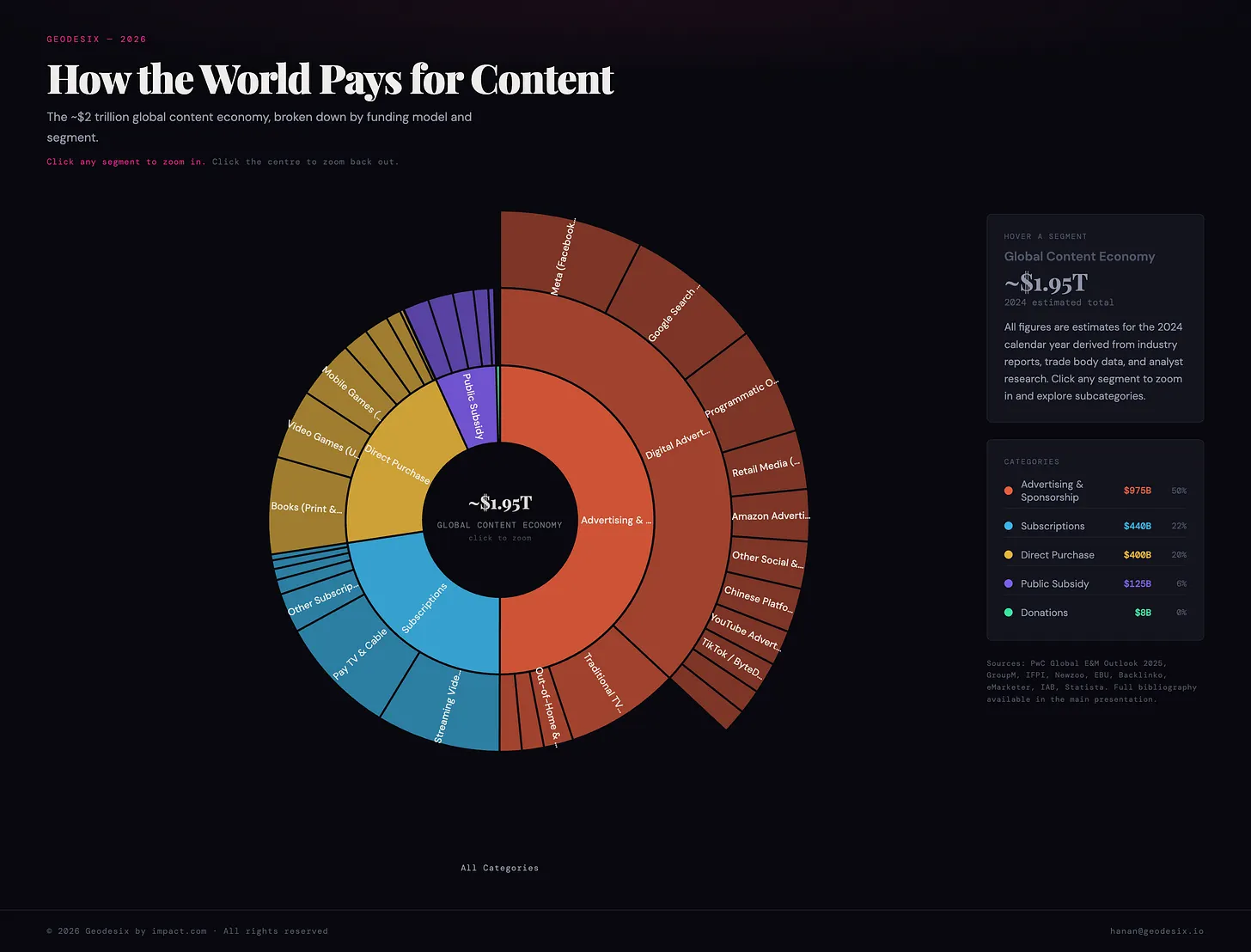
For thirty years, since the ascension of search, advertisers have primarily valued online content for one main thing: audience delivery. The logic was simple: people consume content on publisher properties, and those properties accumulate attention. Advertisers could pay publishers to redirect that attention toward commerce.
Content, in this model, is a top-of-funnel play. Its job is “discovery”, meaning getting new eyeballs to “see” your product. Audience acquisition is expensive and hard, so publishers who could aggregate audiences commanded premium rates. The entire digital advertising economy, the CPMs, the impressions, the programmatic exchanges – it was built around this primary function.
But to the advertisers, what actually lived inside the content (the information, the editorial judgment, the expertise) that was almost incidental. A vehicle for eyeballs. What “really” mattered was whether people showed up, and whether they clicked.
This was never what content was for. But it’s what advertising made it into.
When you reward ‘attention capture’ over substance, you get exactly what you’d expect: an ocean of clickbait, engagement bait, and algorithmically-optimized (“pick-me”) slop. Content manufactured purely to game the attention economy, high on hooks, low on semantic value.
As I’ve written about previously, the internet is drowning in this stuff. Not because anyone wanted it, but because the economic logic demanded it. If content’s value is measured in traffic delivered, then content optimizes for traffic. Substance becomes a means to an end, and in some cases a casualty.
I call this Semantic Pollution, and this is what Kerosene is: ultimately a waste product masquerading as the main output.
AI is the Combustion Engine of our Times
AI changes the equation entirely.
In an AI-mediated world, users increasingly don’t travel to content. They ask questions and receive answers. They make decisions inside environments, shopping interfaces, chat experiences, agent-driven workflows, where content is surfaced at the moment of need.
This breaks irrevocably the audience-delivery model because there is literally no more traffic to redirect. The funnel simply doesn’t start with discovery anymore.
But here’s what’s remarkable: in this AI era, content actually becomes more valuable, not less. Because AI reveals content’s latent property, the one that was always there but couldn’t be monetised at scale: Its ability to shape decisions through meaning and authority!
Advertisers and merchants are discovering that they need content more than ever. But they need it differently. Not up-funnel, for discovery; social creators now do that better, with more engagement and targeting precision. They need content down-funnel, at the consideration phase, where users are weighing options and making choices.
This, is now where authoritative content - expert reviews, comparative analysis, verified data, editorial judgment - becomes indispensable. Not as a traffic channel, but as decision infrastructure.
From Discovery to Action
The implications are profound.
The Content that once lived on destination websites, waiting for users to visit, now can be and needs to be ubiquitous: it needs to exist wherever decisions are made. Inside the retailer’s product page, within the AI assistant’s response, embedded in the shopping experience itself.
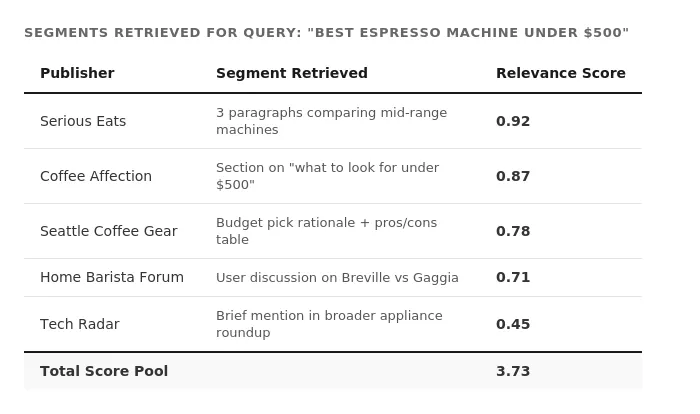
AI makes this possible. Content can travel! As part of its LLM processing, content is atomised, contextualised, and delivered precisely when and where it shapes outcomes.
This isn’t a modest upgrade: it’s a 10x transformation in what content can do within the context of commerce!
In the old model, content (within said contexte) was primarily an acquisition channel, one of many ways to fill-up the top of the funnel. In the new model, content is a conversion imperative. The companies that understand this will embed authoritative content into every decision point. The companies that don’t will watch their competitors’ conversion rates climb while they stagnate.
The Restoration
As I have written before, there’s something “restorative” about this shift, about the reinstatement of curation, authority, and expertise at the top of the value pyramid.
Content was never meant to be an audience-baiting mechanism. That’s what the economics of attention made it into. The best publishers always knew their real value was expertise, judgment, authority, but the monetisation model couldn’t always see it or align with it. The gasoline was always there, but we needed the engine to see it.
AI reveals that value, and makes it transactable. It allows for content to flow to where decisions happen, effortlessly, efficiently, elegantly! Now it remains to implement the infrastructure that ties-in the monetisation, so that creators can be recognised and compensated for their contribution - fairly and transparently. So that this “new gasoline” can keep flowing and power the AI economy.