Blog · Content Economy
What is content worth in the age of AI?
Advertising funds more content than everything else combined, and treats the content itself as worthless. The internet of answers reverses that.
A view from the eyes of a performance marketer.
Ok, let's be real: there is no single answer. Content means different things to different people because it does different things for different people.
But there is one answer that has dominated the economics of content for the past thirty years. And it is worth examining carefully, because it is about to be overturned.
The $975 billion elephant in the room
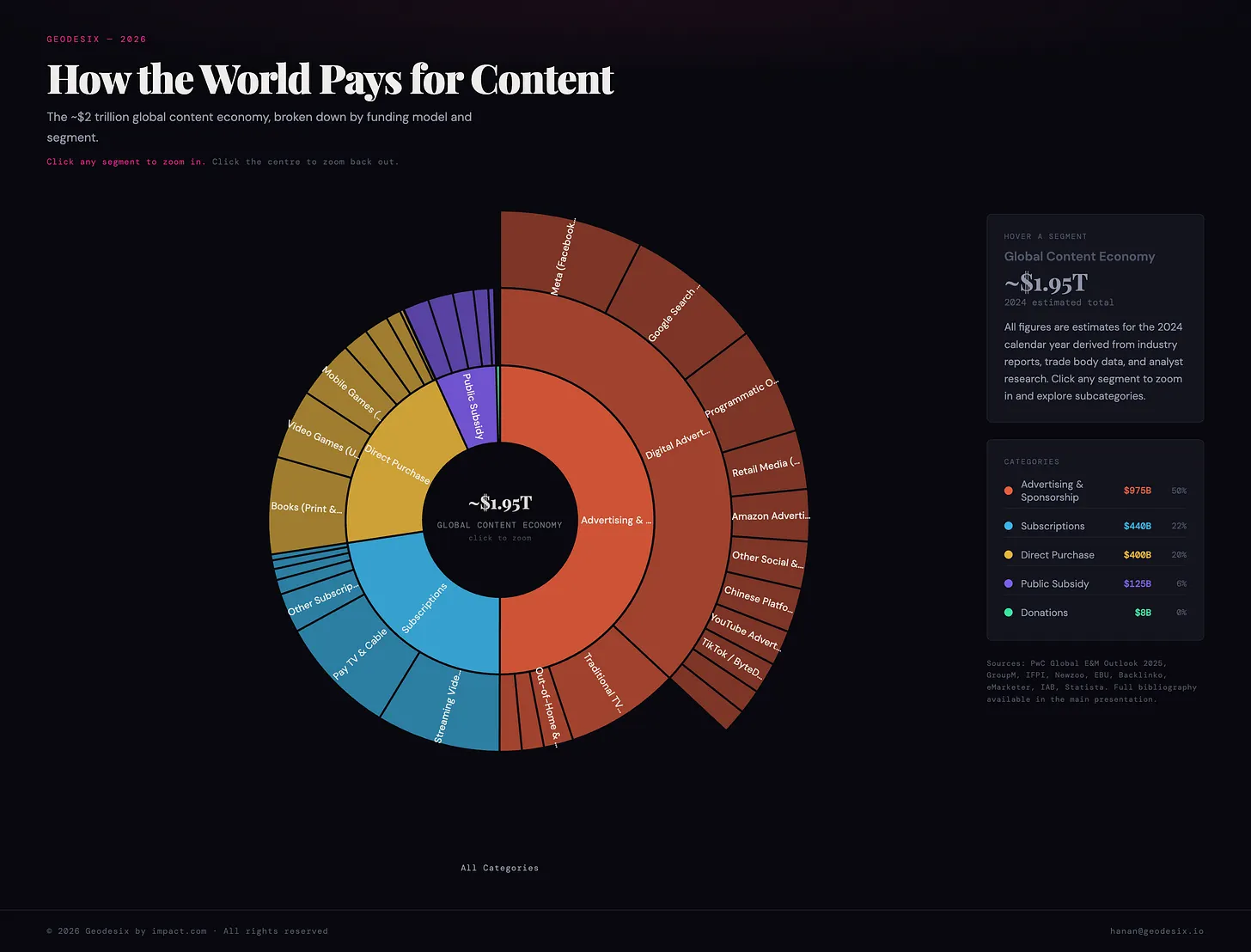
The global content economy is worth roughly $2 trillion a year. It is funded five ways: advertising and sponsorship (~$975B, 47%), subscriptions (~$440B, 22%), direct purchase (~$400B, 22%), public subsidy (~$125B, 7%), and donations (~$8B, less than 1%).
That advertising number is worth pausing on. At $975 billion, advertisers collectively fund more content than subscriptions, direct purchase, and public subsidy combined. In 2024, for the first time, total ad spend crossed $1 trillion (GroupM). The advertising industry has become, by a wide margin, the largest funder of content on the planet.
Which makes it all the more significant that, for advertisers, content itself is essentially worthless! Yes, I said it.
"We don't buy content. We buy audiences."
When an advertiser places an ad in a magazine or on a website, it is not paying for the articles. It is paying for the readers. Content, in this model, is simply an audience delivery mechanism. A proxy for eyeballs. The CPM is the price of renting attention. What lives inside the content, the expertise, the craftsmanship, the editorial judgement, is irrelevant to the transaction.
This is not cynicism. It is the logical consequence of measuring content purely by the attention it harvests.
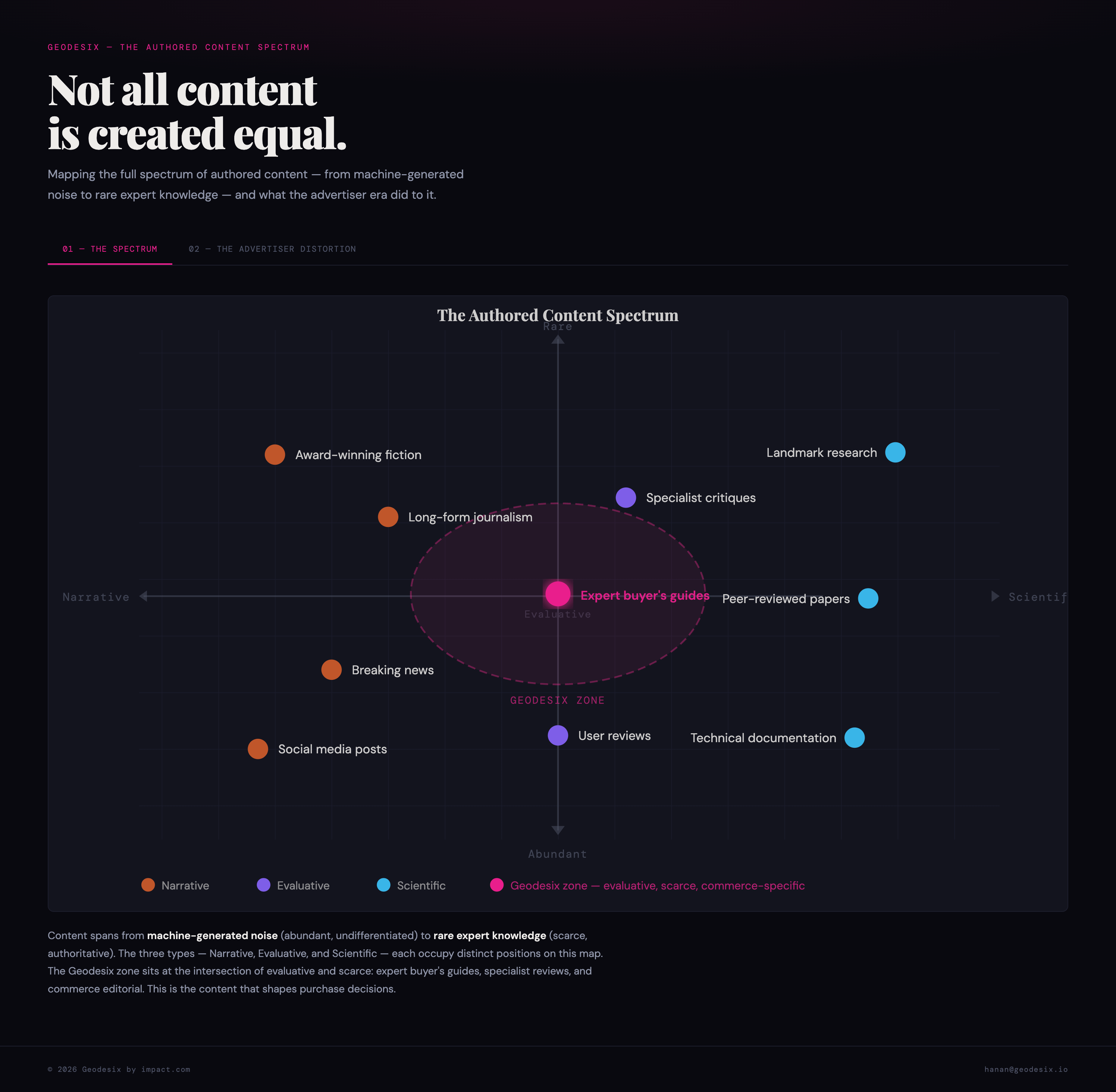
The implications run deep. If content's value is defined by the size of the audience it assembles, then a celebrity Instagram post and a peer-reviewed paper are equivalently valuable just as long as they reach the same number of people. Scarcity of expertise becomes an economic disadvantage, not an asset: the harder your content is to replicate, the smaller your addressable audience. And whenever that dynamic holds, advertisers are perfectly happy to manufacture their own "content" to simulate authority without earning it.
The enshitification was economically rational
The rise of social media and precision audience targeting in the 2010s accelerated this logic to its brutal conclusion. If advertisers could reach the same demographic directly through Facebook's interest graph or Google's search intent signals, then why pay a quality premium for the expensive editorial wrapper?
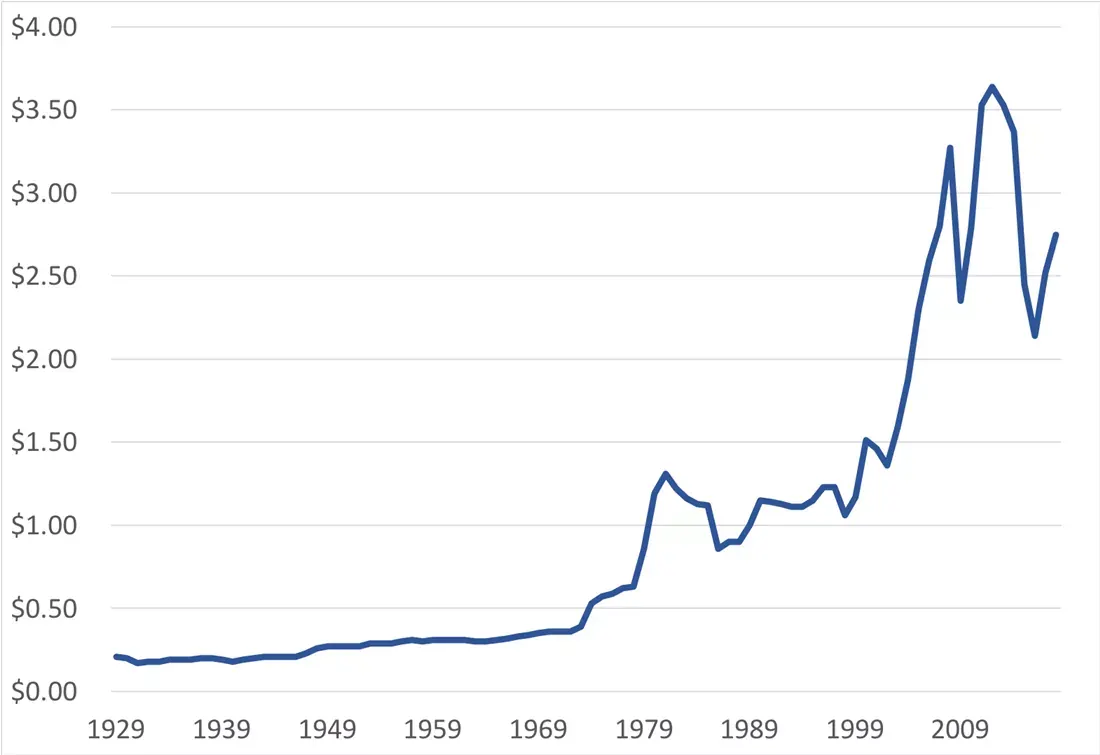
The chart below tells the story clearly. In 2019, traditional media ad revenue still exceeded Meta's. By 2024, Google alone was generating more than twice what all traditional media commanded. Publishers didn't lose their audiences. They lost the ability to charge for them.
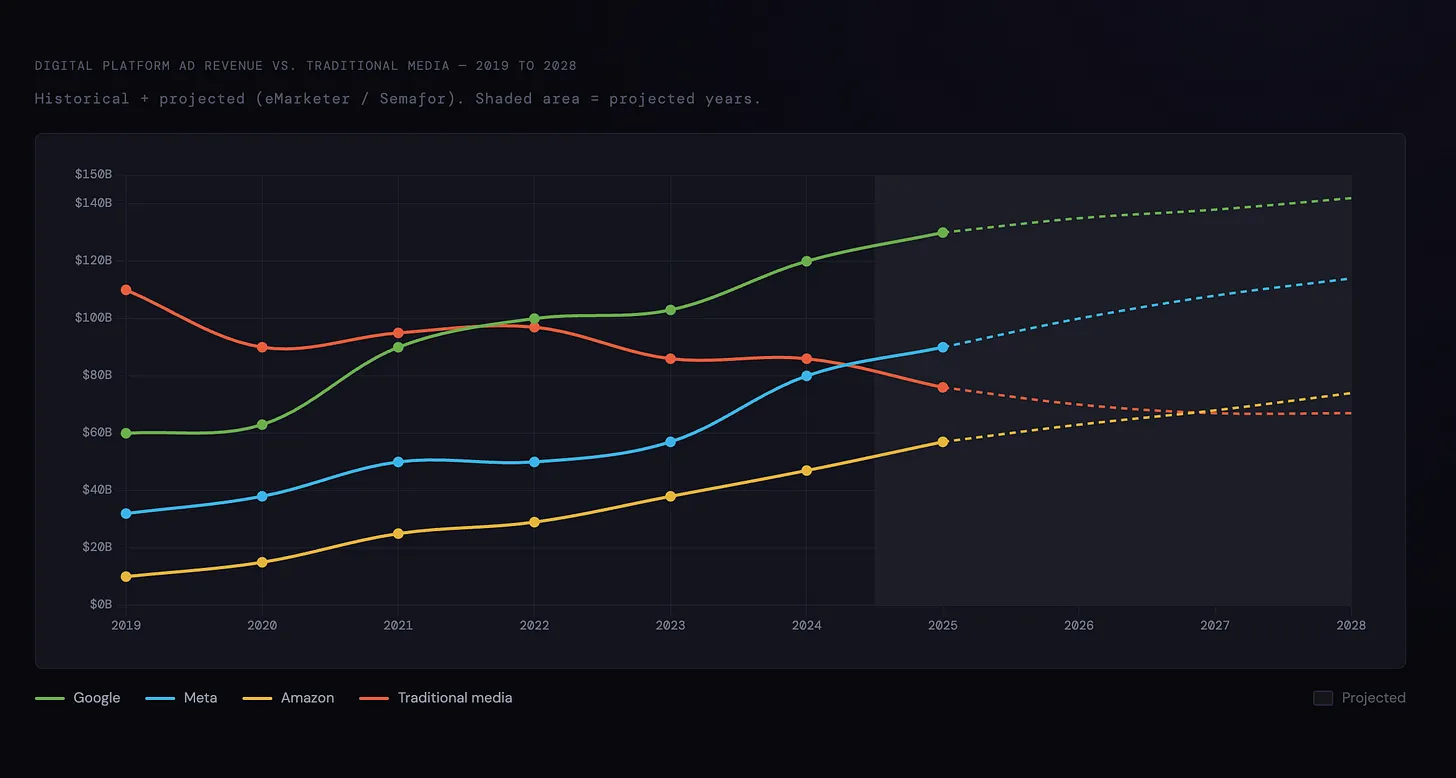
The result was predictable and well documented. Content that optimises for attention rather than quality (clickbait, rage-bait, brain-rot and slop) proved economically superior to advertisers over expensive, expert-driven editorial. This was not a moral failure. It was an economic one.
Then the advent of generative AI industrialised the problem. Millions of pieces of technically passable content, produced at near-zero marginal cost, flooded the web. The signal-to-noise ratio collapsed.
The internet of answers changes everything
In the internet of search, AI was a librarian. It pointed you toward sources. You evaluated. You decided. Content was a destination. The cognitive workload was yours.
In the internet of answers, AI is a teacher. It delivers conclusions. You receive, you trust, you act. Content is the answer itself.
When an AI gives an answer, users typically do not triangulate between sources. They act on it. The tolerance for error drops to near-zero. And the quality of the content behind the answer becomes everything.
The data on this is already alarming. 47% of enterprise AI users made at least one major business decision based on hallucinated content in 2024 (Deloitte). Knowledge workers now spend an average of 4.3 hours per week simply verifying whether what the AI told them is actually true (Microsoft, 2025). 35% of AI responses to news-related prompts contained false claims in 2025, nearly double the prior year's rate (NewsGuard, August 2025). And AI models are 34% more likely to use confident language when generating incorrect information (MIT, January 2025).
The only structural solution is better source content.
When trust is established on the other hand, the loyalty is extraordinary. Trust is the entire business model.
Two predictions
I have spent my career as a performance marketer, which means I am constitutionally sceptical of predictions. But the structural logic here feels unusually clear, and I am willing to stake a position.
Prediction one: the twenty-year erosion of expertise ends
Advertising has never been endemically hostile to expertise, it simply rarely needed it. What advertisers pay for is reach and engagement. Domain authority, editorial standards and years of specialist knowledge matter as audience signals, not intrinsically.
The AI era changes this at a structural level. When the quality of an AI's answer depends directly on the quality of its sources, expertise becomes measurable: not via impressions, but via outcomes. Does the content that informs the AI's answer lead to better decisions? Then it is worth more.
After two decades in which being an expert made you worse at the content monetisation game, that equation is about to reverse.
Prediction two: the future of content monetisation in AI lies in semantic auctioning
My background in economics has taught me that the optimal model for capturing the value of something at a time-sensitive, competitive moment is the auction model. It is what drives almost all programmatic advertising today. I believe it will drive content monetisation in the AI era.
The formula I have been working with:
CV = SQ × IC
Where CV is Content Value: what a piece of content earns in the AI economy.
SQ is Semantic Quality: how authoritative, accurate and relevant the content is. This requires human curation and expertise. It cannot be automated.
And IC is Intent Context: the use case in which the content is deployed. In commerce, this is the user's willingness to buy, ultimately reflected in their order value.
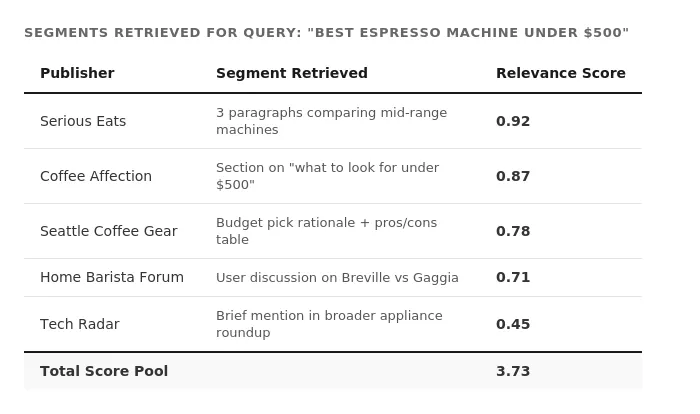
When a user query hits an AI system, rather than picking one winner, the model measures the actual informational contribution of every piece of content in the repository and splits value accordingly. Multiple publishers get rewarded on every single query. Reward is based on hyper-semantic relevance, not an opaque algorithm ultimately designed to benefit the platform rather than the creator.
The best content wins. All of it. Not the best-optimised content. You can read more in Semantic Attribution: How AI Can Finally Fix Critical Issues in Content Monetization.
What we're building
At Geodesix, we are laser-focused on one corner of this map: commerce publishers.
The principles above are global. The implementation needs to start somewhere specific. We chose commerce content, meaning expert buyer's guides, product reviews, gift guides and DIY guides, because it is the category where Intent Context is most measurable: the user's willingness to buy, reflected in their order value.
We license content only from premium publishers. Semantic Quality requires human curation; AI-generated content farms and low-trust sources are excluded. That selectivity is what makes the auction price meaningful, and what makes the resulting answers trustworthy. Our curation is the product.
When a user buys after an AI-guided session, the affiliate commission flows back through the semantic attribution chain, rewarding the publishers whose content shaped the decision in proportion to their actual contribution. Their semantic contribution.
We operate through the Model Context Protocol, meaning content is retrieved in real time, cited and attributed inside the AI's reasoning. Every retrieval is logged. There is no black box.
And we are proudly built on impact.com infrastructure: the world's largest partnership platform, which has been leading commerce-to-content partnerships for 15 years.
The AI era does not create a new model. It restores the original one. Content is being paid for its intrinsic value again: the authority, the expertise, the trust embedded in the words themselves.
For publishers who survived the past two decades with their editorial standards intact, this is the moment they have been waiting for.
H<>M.