Blog · Content Economy
Semantic Attribution: How AI Can Finally Fix Critical Issues in Content Monetization
For decades, content creators have been trapped in two broken games. We believe we have a solution.
For decades, content creators have been trapped in two broken games.
The first is last-click attribution. You write a comprehensive review that helps a consumer understand a product category, compare options, and make an informed decision. But they don’t click your affiliate link. They type the product name in a search engine, land on a retail or coupon site, and buy. The coupon site gets 100% of the commission. You get nothing.
The second is SEO. You’re a genuine expert. Your content is stellar. But Google’s (or Meta’s, or TikTok’s) algorithm decides whether you “deserve” traffic. Creators spend millions optimizing for opaque ranking factors that change without warning. Niche experts who can’t compete or won’t compete get pushed out of the game entirely. You either rank, or you tank.
Both systems share the same fundamental flaw: they’re a sum-zero game, winner takes all.
One publisher gets the click. Two publishers ranks on page one. Everyone else, regardless of how much value they contributed to the consumer’s journey, gets zero.
We’ve just watched this play out spectacularly with the Honey browser extension debacle. Honey was allegedly inserting itself at the last moment of the purchase journey, claiming attribution for sales it didn’t influence, effectively absorbing the commissions from the content creators who actually did the work.
But any industry veteran will tell you that in reality, Honey was just exploiting a system that was already broken. Last-click attribution was never fair. It was just convenient and easy.
AI changes everything. And at Geodesix, we believe it changes it for the better.
How AI Answers Actually Work
When you ask an AI assistant a question like “What’s the best running shoe for flat feet?”, something remarkable happens behind the scenes.
The AI doesn’t make up an answer. It synthesizes information from multiple sources. It might draw insights from Runner’s World’s biomechanics analysis, a podiatrist’s blog post about arch support, a running gear site’s durability testing, and a Reddit thread with real user experiences.
The final answer is a composite. Multiple pieces of content contributed. Multiple publishers added value.
This is fundamentally different from search, where one result gets the click and everyone else gets ignored.
And it creates an opportunity: what if we could measure exactly how much each piece of content contributed to the answer?
That’s Semantic Attribution.
The Math Behind Semantic Attribution
When a query hits the Geodesix platform, our system retrieves relevant content from our publisher network. Each document receives a Semantic Contribution Score ranging from 0.0 (no relevance) to 1.0 (highest relevance).
This score is based on many factors, including:
-
Semantic Relevance: How directly does this content address the specific intent of the query?
-
Depth of Coverage: How comprehensive is the information provided?
-
Recency: How fresh and timely is the information?
-
Query Signals: What does the query itself tell us about what kind of content is needed?
-
Content Scarcity: How unique is this content? Is this the only source covering this topic, or one of many?
We also take into consideration publisher requirements such as price floors and content restrictions, ensuring that compensation reflects both the value delivered and the terms each publisher has set.
Then we calculate each publisher’s Contribution Weight:
Publisher Weight = Sum of Publisher’s Document Scores ÷ Sum of All Document Scores
Let me show you how this works with a concrete example.
Example: “What’s the best espresso machine under $500?”
A consumer asks their AI shopping assistant this question. Geodesix doesn’t retrieve entire articles, it retrieves specific segments of content that are relevant to the query. A single article might contain dozens of segments, but only the ones that actually address the question get scored and compensated.
For this query, our system retrieves relevant segments from five publishers:
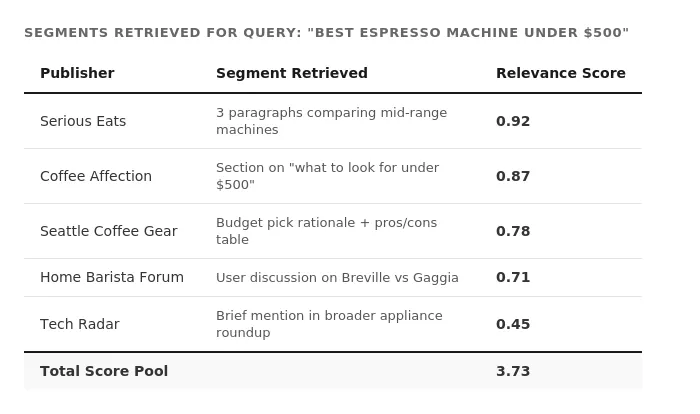
Notice that Serious Eats might have a 5,000-word article on espresso machines, but only the 3 paragraphs specifically addressing the sub-$500 segment are retrieved and scored. The rest of the article isn’t relevant to this query, so it doesn’t factor in.
This is fairer and more precise. Publishers get paid for the specific content that contributed, not for having a tangentially related article somewhere on their site.
Total Score Pool: 3.73
Now let’s calculate each publisher’s share:
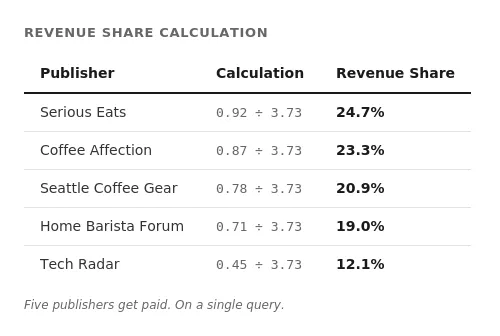
Five publishers get paid. On a single query.
Compare this to last-click attribution, where only one publisher (probably a coupon site) would have received anything. Or SEO, where only the top-ranking result gets traffic.
From Rare Conversions to Millions of Micro-Transactions
Here’s where the economics get interesting.
Under the traditional affiliate model, publishers chase conversions. But conversions are actually rare! A typical affiliate conversion rate is 1-3%. And thanks to attribution issues, even when a conversion happens, the publisher who actually influenced the decision often doesn’t get credit.
So publishers are left hoping for a handful of properly-attributed conversions per month, each worth a few dollars in commission.
Semantic Attribution flips this entirely.
Instead of waiting for rare, high-value conversions that may or may not be attributed correctly, publishers get paid for every query their content helps answer. Not just the queries that lead to purchases. Every single one.
Think about the math: millions of AI queries happen every day. Each query that touches your content generates a micro-payment. These micro-payments add up fast.
A vertical coffee blog might never win a last-click attribution battle against a major coupon site. But if their content helps answer thousands of espresso-related queries daily, they’re earning on every single one. The volume of micro-transactions dwarfs the occasional properly-attributed affiliate sale.
This is a fundamentally different revenue model. Consistent. Predictable. And directly tied to the actual value your content provides.
Why Both Horizontal and Vertical Publishers Win
One of the most common concerns we hear is: “Won’t the big publishers dominate and squeeze everyone else out?”
Under last-click and SEO, that concern is valid. Scale and domain authority matter more than expertise. The big players win because they can outspend everyone on optimization.
Semantic Attribution works differently. It rewards two distinct types of value:
Horizontal publishers win through coverage.
If you’re a publication with content spanning hundreds of product categories, you’ll show up in more queries. Your breadth is an asset. When someone asks about running shoes, you have running shoe content. When they ask about espresso machines, you have that too. When they ask about travel gear, you’re there.
Volume matters. More queries touched means more micro-payments accumulated.
Vertical publishers win through content specificity.
But here’s what’s different: when someone asks a highly specific question, the vertical expert often scores higher than the horizontal publication.
“What’s the best espresso machine under $500?” might pull content from both a major tech publication and a dedicated coffee blog. The tech publication has broader coverage, but the coffee blog’s content is more precisely relevant to this specific query. Their relevance score is higher. They get a larger share of this particular payment.
In our example above, Seattle Coffee Gear earned 20.9% of the query revenue despite being a smaller publisher. That’s because their “Budget Espresso Deep Dive” directly addressed the price constraint in the query. The semantic model recognized this specificity.
Horizontal publishers accumulate value through scale. Vertical publishers accumulate value through depth. Both strategies work. Both get rewarded. This isn’t zero-sum.
A Better Model Than “Pay to Scrape”
Right now, the dominant model for AI and content is simple: scrape first, negotiate later (maybe).
Companies hoover up content from across the web, use it to train models and generate responses, and publishers see nothing. When publishers complain loudly enough, sometimes there’s a licensing conversation. Usually there isn’t.
This is “pay to scrape” at best. More often, it’s just scrape, without the ‘pay’. Semantic Attribution offers something fundamentally different:
Transparency: Publishers see exactly which content was accessed and what was used, for which queries, with what relevance scores. Every micro-transaction is auditable.
Ongoing revenue: This isn’t a one-time buyout. Every time your content contributes to an answer, you earn. As AI usage grows, your revenue grows.
Fair distribution: Payment is proportional to actual contribution. Content that’s more relevant to a query earns more. The system rewards quality, not just availability.
Publisher control: You decide what content to make available. You can withdraw at any time. You retain full ownership.
This is what content licensing should look like in the AI era: vertical collaboration and partnership.
A Win/Win/Win Model
We designed Geodesix around a simple principle: the model only works if everyone benefits.
This isn’t altruism. It’s alignment of incentives.
We’re committed to publisher health because a healthy publisher ecosystem produces better content, which makes AI better, which attracts more AI customers, which generates more revenue for publishers. The flywheel only spins if publishers thrive.
That’s not just our business model. It’s our mission.
Join the Beta
We launched Geodesix in beta this week. If you wan’t to be a part of our amazing dynamic community, sign up at geodesix.com or subscribe to my Substack!