Blog · AI and Search
The Post-Search Internet: Why Curated Vertical Knowledge Will Replace Traditional Search
AI agents are fundamentally reshaping the economics of online information and why the solution lies in semantic curation, not algorithmic gatekeeping.

The Quiet Revolution Nobody’s Talking About
Within the next two to three years, the majority of online information searches will be conducted not by humans typing into Google, but by AI agents working on our behalf. These aren’t the chatbots of yesterday’s customer service nightmares. These are sophisticated systems that can conduct research across hundreds of sources simultaneously, synthesize conflicting information, identify patterns humans would miss, and deliver precisely what we need, sometimes before we even know we need it.
LLMs are several orders of magnitude better at search than humans. They can go deeper, wider, and faster. They can find needles in haystacks that would take expert researchers months to uncover. And most importantly, they never get tired, distracted, or overwhelmed by information overload.
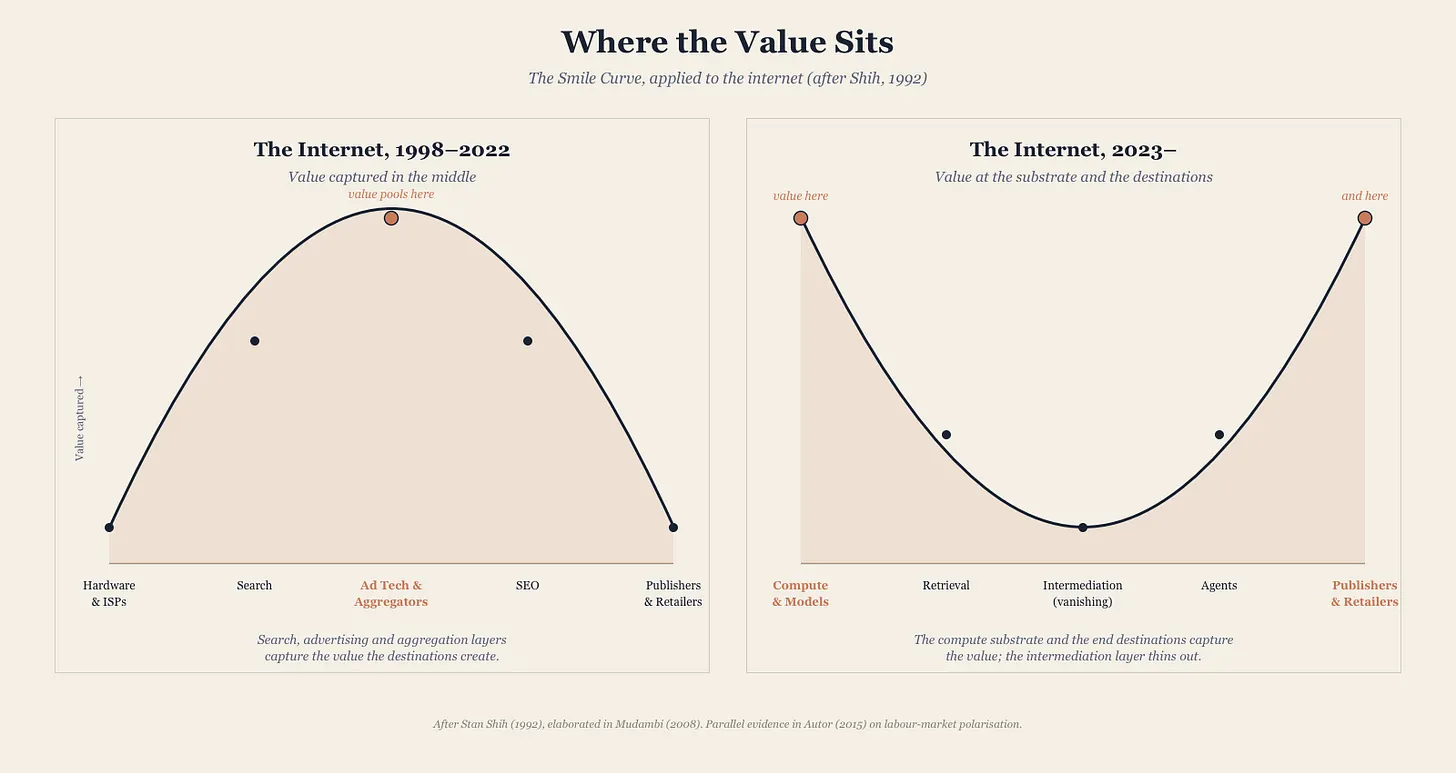
This is the dawn of what I call the post-search internet: an era where traditional “human-centric” search engines become obsolete middleware, and direct semantic connections between knowledge sources and AI systems become the primary infrastructure of information flow.
But there are two big problems.
The Two Fundamental Failures of Search-as-Middleware
Problem One: Search Was Never Built for Machines
Google and Bing’s algorithms were designed to produce results that look appealing to human eyes. The focus is on metadata: headlines, descriptions, link text etc, optimized to generate clicks, because that’s what makes Google money!
This worked fine when humans were doing the clicking. We could scan headlines, assess credibility at a glance, and decide what to read. But when AI agents are doing the searching, this superficiality becomes a critical bottleneck.
Current search APIs return:
- Limited quantity (typically 10-20 results)
- Surface-level metadata (titles, snippets)
- Ranking is a ‘blackbox’, but safe to assume it’s optimized for human CTR
- Content that can be “gamed” through SEO manipulation
For an AI trying to synthesize comprehensive, accurate answers, this is like trying to write a research paper using only book covers and table of contents. The knowledge is there, but the access mechanism is fundamentally inadequate.
Problem Two: The Economics Have Collapsed
Here’s where things get existential for publishers.
In the old model:
- Google indexes content
- Humans search Google
- Humans click through to publisher sites
- Publishers monetize through ads and affiliate revenue
In the new model:
- Google indexes content
- AI searches Google
- AI synthesizes answer from multiple sources
- Human gets answer without ever visiting publisher sites
- Publishers get... nothing
OpenAI reportedly pays Google approximately $0.003 per API query. With nearly 1 Billions AI queries daily, and growing at 4-5% per month, let’s assume that only 5% of those are RAG queries - that’s roughly $150,000 per day (~$4.5 million per month) currently flowing from AI companies to search engines.
Meanwhile publishers, the actual creators of the knowledge being accessed, receive zero compensation. Their content is being used, their expertise is being monetized, but the financial circuit has been severed.
Some publishers have called this “an existential threat to the open web economy.” They’re not being dramatic. They’re being realistic.
The Death of Search as We Know It
Let’s be clear about what’s happening: traditional search is becoming obsolete.
Not because it’s bad at what it does, but because what it does is no longer what we need. Search was built for a human-in-the-loop model where:
- Humans formulate queries
- Humans evaluate results
- Humans click and read
- Humans synthesize conclusions
The AI-mediated model eliminates most of those steps. When you ask ChatGPT a complex question, you don’t want ten blue links, what you want is an answer! And increasingly, you’re getting one.
The question isn’t whether this shift will happen. It’s already happening. The question is: what replaces search?
Vertical Knowledge Networks - A New Semantic Layer
The answer, I believe, lies in moving from horizontal aggregation (search across everything) to vertical curation (deep semantic indexing within domains).
Instead of a single search engine trying to rank the entire internet, imagine specialized knowledge networks for specific domains:
- Consumer & Commerce: Product reviews, buying guides, comparative analysis, expert recommendations
- Travel & Hospitality: Destination guides, accommodation reviews, itinerary planning, local expertise
- Health & Wellness: Medical information, treatment options, research summaries, practitioner insights
- News & Current Affairs: Reporting, analysis, investigative journalism, expert commentary
Each vertical would be:
- Semantically indexed at the content level (not just metadata)
- Curated for quality (not gamed through SEO)
- Real-time updated (not stale training data)
- Directly accessible via APIs to AI systems
- Fairly monetized for content creators
This isn’t science fiction. The technology exists today. What’s missing is the infrastructure and the economic model.
How Semantic Indexing Actually Works
Let me get technical for a moment, because this is where the magic happens.
Google’s PageRank algorithm looks at:
- Usage patterns (how many people visit)
- Link structures (who links to whom)
- Source trustworthiness (subjective assessments)
- Metadata (titles, headers, image descriptions)
But crucially, it struggles with the actual semantic content, the words, paragraphs, and ideas in the body of the page. This creates a massive bias toward large, frequently-accessed sites. Smaller publishers with excellent content but less traffic become invisible.
Semantic indexing flips this model.
Instead of ranking pages by popularity, we can:
- Embed entire content corpora using domain-specific language models
- Cluster semantically similar content into “topics”
- Characterize each document by topic and semantic similarity scores
- Create searchable indexes based on meaning, not metadata
When an AI system queries this semantic layer, it’s not getting ten headline snippets. It’s getting comprehensive, contextually-relevant content matched directly to the query’s semantic intent.
Some experiments we’ve conducted show that this approach is up to 100x faster than traditional search while returning dramatically higher-quality results. More information, lower cost, better accuracy.
The Three-Way Win: Users, AI, and Publishers
What makes this model compelling is that everyone benefits:
Users Win
They receive more reliable, comprehensive answers synthesized from higher-quality sources. No more wading through SEO spam, clickbait, hallucinations and contradictory information scattered across dozens of sites.
AI Systems Win
They get access to better data at the same or lower cost, making their outputs more accurate and trustworthy. Training and refinement become easier when the knowledge base is structured semantically rather than just scraped from the web.
Publishers Win
For the first time in the AI era, they get paid every time their content is accessed. Not through advertising impressions or clickthrough rates, but through direct compensation for the value of their knowledge.
This is a fundamental realignment. Instead of publishers competing for attention in a zero-sum attention economy, they’re compensated for expertise in a positive-sum knowledge economy.
Why This Could Fix Online Publishing
The past twenty years have been brutal for online publishers. Google positioned itself as the “traffic warden” of the open web, controlling access while extracting most of the economic value from audiences before redirection.
This led to a race to the bottom:
- Clickbait headlines over substantive content
- SEO manipulation over editorial integrity
- Volume over quality (publish 50 mediocre articles rather than one excellent one)
- Ad overload making sites barely usable
Publishers knew this was degrading their work, but often had no choice. If you don’t have enough brand equity to command subscription dollars, the realistic alternative was invisibility.
A semantic knowledge network model changes the incentive structure completely. Publishers are now rewarded for:
- Depth and accuracy of content
- Semantic relevance to queries
- Expertise and trustworthiness
- Comprehensive coverage of topics
The better their content, the more often it’s accessed, the more they earn. It’s that simple.
The Challenges Are Many!
I’d be dishonest if I didn’t acknowledge the significant challenges:
Publisher Skepticism: Many publishers are (rightfully) wary of yet another platform promising to “fix” their problems. They’ve been burned before.
Technical Complexity: Building high-quality semantic indexes requires significant expertise in NLP, embedding models, and real-time data processing.
Attribution Opacity: How do you fairly attribute value when an AI synthesizes information from 50 sources? This isn’t a solved problem.
Market Coordination: This only works if enough high-quality publishers participate. It’s a classic chicken-and-egg problem: AI companies won’t pay for a sparse network, publishers won’t join without proven AI demand.
Economic Sustainability: What’s the right price point? Too high and AI companies stay with Google. Too low and publishers don’t see meaningful revenue.
These aren’t insurmountable, but they’re real. Building the post-search internet isn’t just a technical challenge—it’s a coordination problem that requires trust, transparency, and aligned incentives.
What Comes Next
The transition from search-mediated to AI-mediated information access is inevitable. The question is whether we build the infrastructure deliberately and equitably, or whether we let it emerge chaotically with the same exploitative economics that plagued the search era.
I believe we’re at an inflection point. The technology is ready. The market need is clear. What’s missing is the will to build something different, that doesn’t just shuffle the same money between different tech giants, but creates a genuinely sustainable that benefits knowledge distribution.
The post-search internet will be built. The only question is by whom, and for whom.