Blog · AI and Search
If Teleportation Came Tomorrow
A thought experiment about travel and what it reveals about the "Post Search" internet era.
Suppose, tomorrow morning, someone announces that teleportation is real. The working, commercial kind. You step onto a pad in your living room and step off, an instant later, in Tokyo, or in your dentist’s waiting room, or in the garden of a friend you have not seen in years. The cost, let us say, is roughly what a plane ticket costs today. The energy bill is enormous, and the world is busily building nuclear plants to keep up.
What happens?
The question sounds like a parlour game, but it turns out to be one of those thought experiments that disciplines your thinking about something else entirely. I have been turning it over because I think it tells us something useful about what large language models are doing to the internet.
The analogy is imperfect, as are all analogies. Yet it’s useful in my opinion since human minds handle disruption asymmetrically. Physical disruptions are much easier to imagine; we feel their consequences immediately. Epistemic disruptions on the other hand, the kind that change how we know things rather than how we move through space, stay harder to feel even when we are already inside them. The teleport thought experiment borrows the clarity of the physical to illuminate the murkiness of the epistemic. We can picture what it would be like if the journey to a place vanished. We are still, in 2026, fumbling for words to describe what it is like now that the journey to an answer has vanished.
So let me try it on you.
What dies
Imagine teleportation arriving and your first instinct is that the travel industry is finished. It is, in a particular way. The casualty is the middle of the journey. Everything whose business model quietly depends on people being trapped in transit, on the suspended hours between origin and destination, gets compressed to almost nothing.
Consider the airline. Consider also, and more interestingly, the airport. The airport was always a retail mall that happens to sit downstream of a security checkpoint, monetising the captive boredom of millions of people who have nowhere else to be for the next two hours. Duty free, the over-priced sandwich, the lounge subscription, the rental car desk, the airport hotel, the airline credit card, the loyalty programme, the in-flight magazine, the seat-back screen with its inexplicable selection of films. All of it is the frictional residue of travel, value extracted from the gap between wanting to be somewhere and being there. Remove the gap, and the residue evaporates.
You can extend the list outward in concentric rings. Travel agencies that sold you the routing. The freight side of aviation, if cargo teleports too, which would collapse Boeing’s order book, the jet fuel supply chain, and a meaningful slice of global insurance. Highway-exit motels. The truck-stop diner. Trip-interruption insurance. The GPS-routing layer that exists to optimise journeys that no longer happen. Frequent-flyer programmes, whose entire premise is that you should feel rewarded for the time you wasted in transit.
Every one of these is a toll booth on the road to the destination. Teleportation kills them all.
The shape of what dies matters here. The pattern is anything that monetised the friction of getting there. That distinction will do most of the work for the rest of the essay.
What thrives
The second-order effect takes a moment to see.
If teleportation costs what flying costs today, demand for being in places explodes. Friction was suppressing demand all along, and the suppression has just been lifted.
Hotels in Tokyo book out. Restaurants in Tokyo book out. Museums, concerts, stadiums, conferences, hospitals doing medical tourism, universities running in-person seminars. Real estate in any city interesting to be in gets repriced upward, because the addressable market for being there is suddenly global rather than regional. The Cotswolds become a viable commute to Manhattan. A surgeon in Boston, a luthier in Cremona, a tailor in Naples; each of them wakes up to find their order book has gone planetary overnight without their having to change anything about what they actually do. The premium of being in their presence holds steady. The cost of entering it falls to zero.
A third-order effect follows. Live performance gains in value. A concert by an artist you love was always partly a logistical achievement, a thing you did because you fought through traffic and parking and ticketing to be present. Strip the logistics out, and the concert sells one thing: the moment itself. The moment becomes the entire product. Scarcity migrates from the journey, where it had been hiding, to the event, where it always quietly belonged.
So far the airline is gone and the destination has gained. Beyond those two, a third thing happens, and the third thing is the most interesting.
Inefficiency becomes a luxury
Once the efficient option exists, the inefficient option becomes available as a signal. You took the train from Paris to Istanbul. You spent three days getting there. You had the time and the means to opt out of the teleport. The journey, once required, becomes a so called “Veblen good”, a status object whose entire value is the visible refusal of the cheaper, faster path.
Travelling by plane becomes the new Transatlantic ocean liners or Orient-Express. Slow travel becomes to fast teleportation what slow food became to fast food: a luxury category defined by its refusal of the efficient alternative.
The principle generalises beyond travel. Whenever the efficient version of a thing becomes free or near-free, the inefficient version transforms into art.
If teleportation costs what flying costs and burns enormous amounts of energy, the chokepoint of the entire system has migrated. The old bottleneck was the airline, the runway, the air traffic control system, the limited slots at Heathrow. The new bottleneck is the electricity grid. Whoever owns the nuclear plants that power the teleport network owns the new toll road. The marginal cost of moving a body becomes a function of the marginal cost of a kilowatt-hour. The powerful companies in the post-teleport world bear the names of utilities and reactor operators and grid infrastructure firms, plus the names of the destinations themselves.
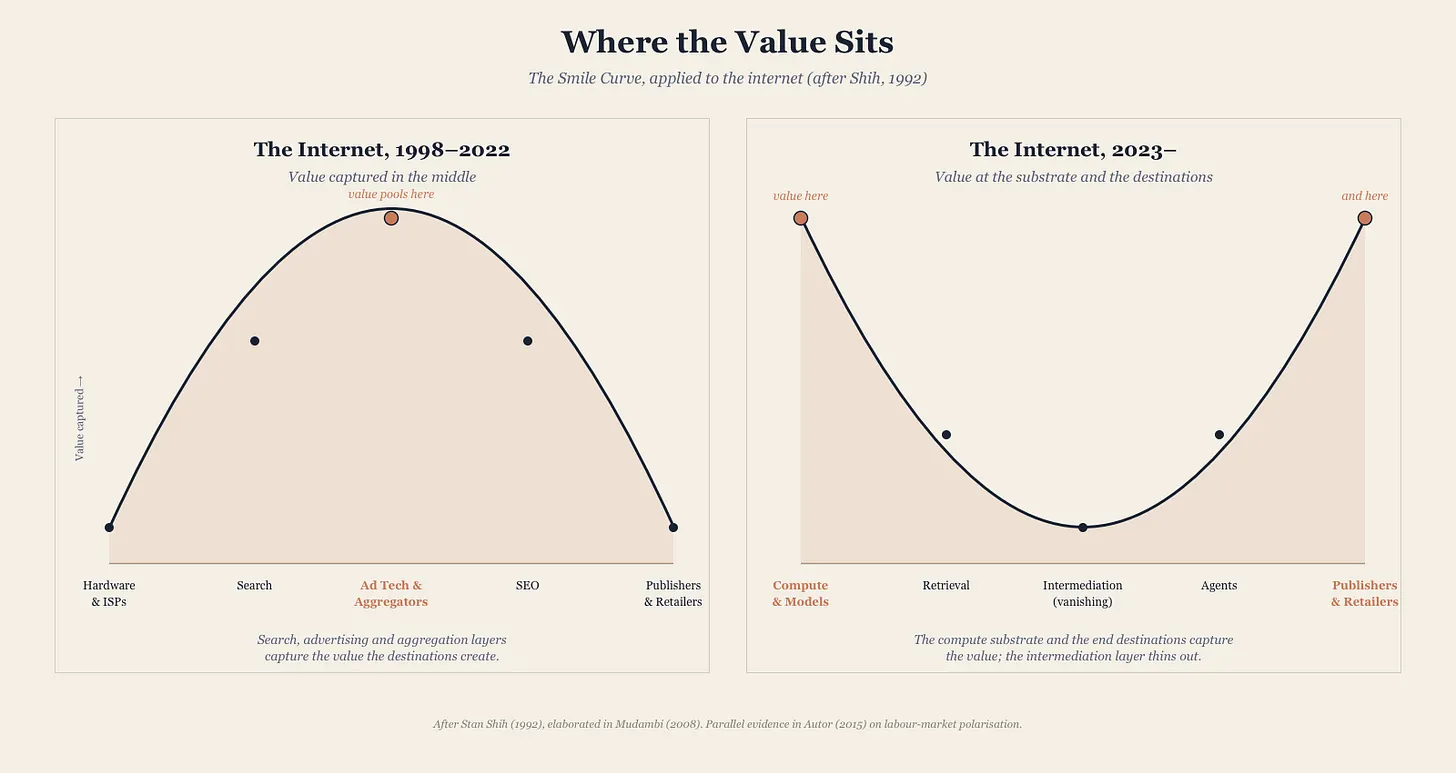
Value has fled the middle of the chain and reconcentrated at the two ends (“The Smile Curve”). The substrate that powers the new mode of transport, and the destinations the new mode of transport delivers you to. Everything between thins out.
Now, the internet
For thirty years, the internet has worked the way pre-teleportation travel worked. There was a place you wanted to get to, an answer, a product, a recipe, a fact, and a vast intricate infrastructure of intermediaries existed to ferry you there. Search engines, ad networks, SEO consultancies, comparison sites, content farms, link aggregators; the entire architecture of getting from a question in your head to a result on a page. The internet was an airport. The destinations existed (the publishers, the retailers, the experts) but the airports between you and them held most of the money.
Large language models are the teleport. You ask a question and the answer is in front of you. The ten blue links, the cookie banner, the advertorial, the scroll back up to find the paragraph you actually wanted: all gone. The thing you were looking for appears, in seconds, in front of you. The journey has vanished.
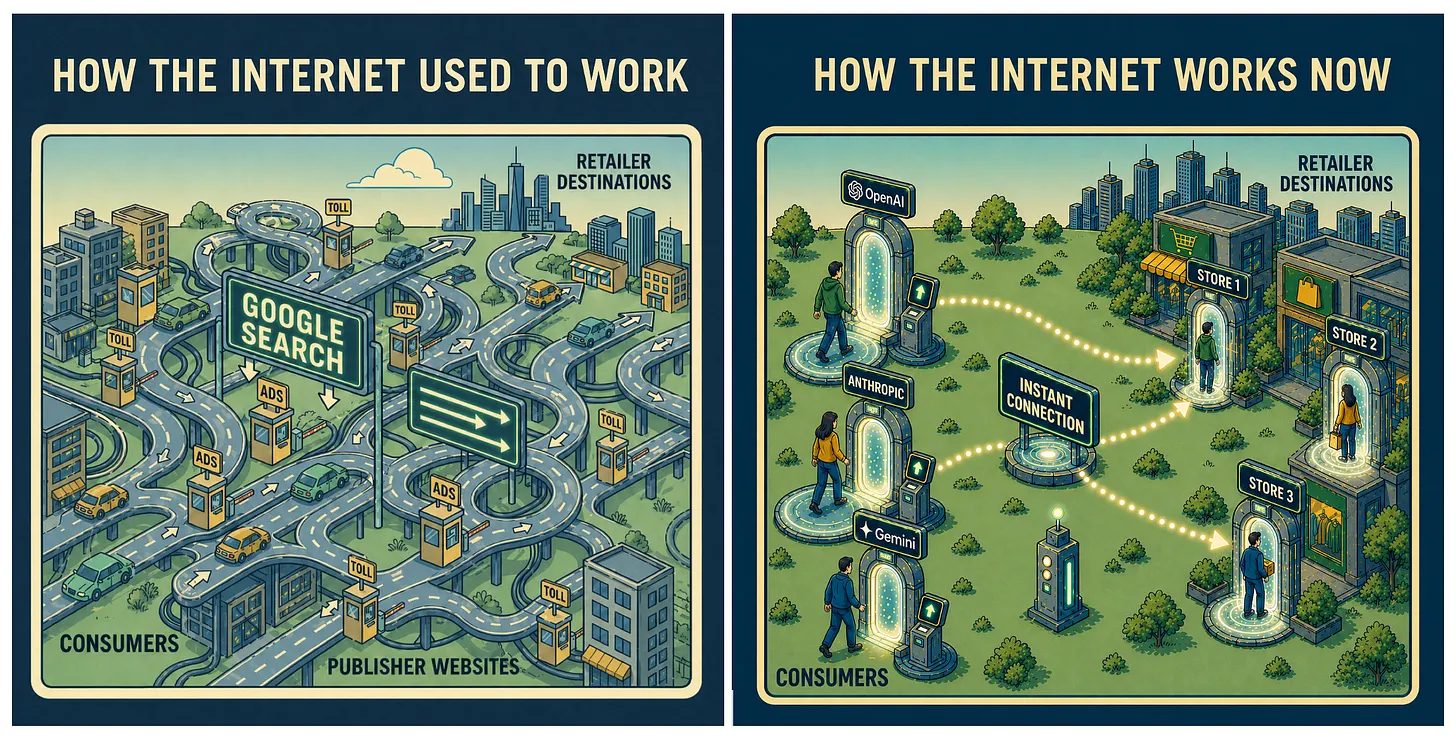
The same asymmetry holds. The casualty is the middle of the internet, the part that monetised the friction of getting to the answer. Search as a destination. Advertising tied to the act of searching. SEO as an industry. The entire economic logic of routing attention through intermediaries who add nothing to the answer but charge a fee to deliver you to it. The toll booths. Teleportation will kill them too.
The destinations gain value. A publisher who actually knows something. A retailer selling real products that consumers want to buy. A reviewer with taste you trust. An expert with a long track record. These were always what people were trying to reach. They had been trapped behind a lattice of intermediaries that extracted most of the value before the user arrived. Take the lattice away, and the destinations remain standing. They are the only things left that matter.
The chokepoint has moved. Everything between thins out.
What comes next
If you are a brand, a retailer or a publisher and you are producing things that humans want to consume - you are about to be promoted!
For thirty years, you were a destination people had to be ferried to, paying tolls along the way. In the new world, you are now the destination an agent arrives at, and the agent’s only job is to deliver the user to you cleanly and correctly. The friction belonged to the airport, and the airport is closing.
What is required of you is to be worth teleporting to. Nobody teleports to a parking lot.