Blog · AI and Search
The Death of Search, the Birth of Answers
Part 1: How Google Broke the Internet (and Why AI Might Fix It)
When the internet came into my life nearly thirty years ago, it ploughed through old conventions like a tsunami. “New Media,” as it was called, was a catchall term for content that ordinary people could create, publish, and even earn money from. (The word “monetize” came later, along with a lot of other crimes against language.) This revolution was powered by trailblazers like WordPress and YouTube, then accelerated by the horizontal shockwave of social media.
It was DIY. It was Punk. And as someone who was deep into the Punk Rock and Metal scene, that was probably a big part of the appeal that drew me, and many like-minded people, into this strange new world.
And of course, there was Google.
Google became the de facto operating system of the internet, in exactly the same way Microsoft Windows was the operating system of personal computing. You couldn’t really use the internet without it. Search was the lifeline and the bloodstream that powered everything.
The Quiet Heist
There’s a lot to be said about the trials and tribulations of the decades that followed. Many books have been written about Google’s genius: their strategic brilliance, their product leadership, their uncanny ability to seem benevolent while building a $2.3 trillion empire.
In my opinion, not enough has been written about the sophisticated and rather Machiavellian ways in which Google gradually extracted value from the rest of the internet and concentrated it in Mountain View. But that’s for another post.
What’s clear to me is this: Google’s search engine changed everything about how humans interact with information. In a sense, it changed the very fabric of information itself, where it comes from, why it’s created, how it can be used.
As I write these words, millions of people are creating new content with Google’s information distribution principles baked into its DNA, whether they’re consciously aware of it or not. Don’t believe me? Google it! 😊
The “Pick Me” Internet
Google taught an entire generation that if you write text in a way that pleases the algorithm, that text could reach millions of people. This was a feat previously reserved for credentialed experts and well-connected insiders operating under the patronage of old media giants, the big publishers and the printed press.
Suddenly, anyone could become famous. Rich. A respected expert, irrespective of their actual expertise. Social media spotted this early and adopted the approach with unprecedented zeal. The result is the current sad state of the internet, where a staggering proportion of information isn’t loyal to truth or epistemological principles, but is instead driven by the lure of algorithmic success.
It’s all “Pick Me” content, designed to satisfy algorithmic trend parameters rather than to inform, enlighten, or even entertain.
For those trying to become famous or make a living, the winning formula is always “engagement”: shock, sensationalism, endorphin loops, controversy. The more sinister operators, those trying to exert covert influence through disinformation and misinformation, use exactly the same playbook.
The Real Diagnosis
So when people complain that “the internet is shit,” as I hear with increasing frequency, what they really mean is that Search is shit, because Search isn’t just the layer that users use to retrieve information, Search is imprinted in almost every piece of data that’s being created.
The system that powers the internet has trapped itself in a negative feedback loop: bad content gets created to game the algorithm, the algorithm rewards and promotes it, which incentivizes more bad content. Rinse, repeat, until the internet of 2026 feels somehow inferior to the internet of 2006.
Some argue that AI will inevitably make things worse, that it will finish the internet as we know it for good. I understand the fear. When everyone has access to tools that can generate infinite complex content at zero marginal cost, won’t we just drown in even more algorithmic slop?
I think those who hold this view are being short-sighted.
A Different Thesis
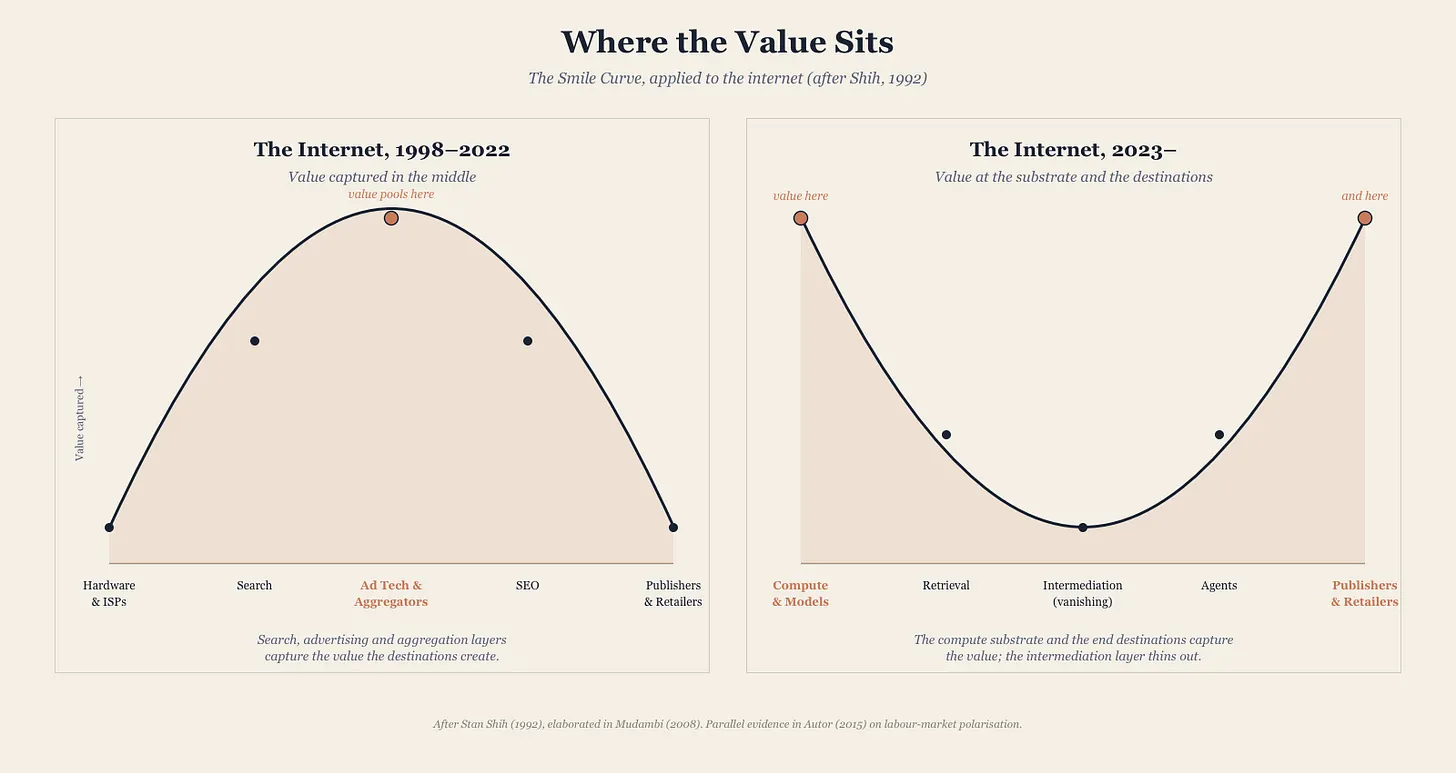
I believe AI is the Schumpeterian force of “Creative Destruction” whose ultimate effect will be to kill “Pick Me” content and the ailments that came with it. In its place, I think we’ll see expertise, authority, and curation restored as the north stars of the information economy.
I admit this sounds a lot less Punk Rock than the democratized chaos of the early internet. Perhaps that’s related to the fact that I’m not seventeen anymore. But I genuinely can’t wait for it to happen.
My take is that this isn’t just inevitable, it’s actually a good thing. We may be reverting to something closer to a pre-internet knowledge economy, where credentials and track records matter, where curation adds real value, and where expertise isn’t something you can fake with keyword density.
But to understand why I believe this, we need to take a moment to examine the last days of Rome.
Coming in Part 2: What the fall of the Roman Empire can teach us about the future of content, and why the “Answer Era” might be humanity’s best hope for escaping the algorithmic swamp.