Blog · AI and Search
The Death of Search, the Birth of Answers II
Part 2: The Return of the Experts

In Part 1, I argued that the double vectors of democratised content creation and algorithm-driven distribution have led to a marked deterioration in the quality of information we consume online. Search engines and social media platforms, optimised for clicks and engagement rather than truth or utility, have buried authoritative content under heaps of “Pick Me” slop, carefully crafted to please the algorithms that distribute it.
Which brings us to Rome.
The Last Days of Rome
In the final centuries of the Roman Empire, the institutions that had once made Rome great began to hollow out. The Senate still met, the legions still marched, the aqueducts still flowed. But the substance behind these forms had degraded. Offices that once commanded respect became commodities to be bought and sold. The currency was debased so many times that people stopped trusting it altogether.
The internet in 2026 feels a bit like that. The infrastructure is more impressive than ever. The platforms are sleeker, the algorithms more sophisticated, the content more abundant. And yet something essential has been lost. We scroll through endless feeds and come away feeling somehow less informed than before.
When Everything Is Content, Nothing Is
This explosion of low-quality and outright bad content has contributed, in my opinion, to a sense of nihilism that many of us feel when we’re online. Nietzsche captured this feeling over a century ago in Thus Spoke Zarathustra: “All is alike, all hath been... all knowledge strangleth.”
He was writing about the exhaustion that comes when everything has been said, when novelty becomes impossible, when the sheer weight of accumulated information crushes the possibility of genuine insight. Sound familiar?
When authoritative expertise is displayed alongside, or buried under, algorithmically optimised nonsense, how do you tell the difference? When every opinion is presented with equal prominence regardless of its merit, how do you know what to trust? The cognitive load required to separate signal from noise has become unbearable.
The Great Escape
I think the phenomenal rise of LLMs that we’re witnessing is directly related to this exhaustion. Users want a way out of the slop and decay that is crippling the internet. They don’t want information, they want knowledge. They don’t want noise, they want clarity. And getting those things from the current internet requires serious cognitive effort, which LLMs are helping to alleviate.
We are transitioning from the era of Search, where people ask questions and get information, to the era of LLMs, where people ask questions and get answers.
This distinction matters more than it might first appear. An “answer” is not merely a collection of data points. It’s a complex, context-sensitive synthesis of semantics and information. It requires judgment, interpretation, and the ability to weigh competing claims.
And here’s the interesting part: an answer has a characteristic that search results don’t. An answer can be true or false.
The Truth Problem
Defining “truthness” and “falseness” are questions that have preoccupied philosophers for millennia. They are proving to be extraordinarily pertinent in this emerging field of AI.
Because there’s a catch. If LLMs can’t give us “good” answers, which we can reasonably assume means “true” answers, then nobody will use them. The tolerance for hallucination, for confident wrongness, for plausible-sounding nonsense, is surprisingly low. Users are fleeing the algorithmic swamp precisely because they’re tired of wading through unreliable content. They’re not going to accept more of the same from a chatbot, no matter how politely it’s delivered.
This creates a powerful market pressure that the Search era never had. Google’s business model didn’t really depend on the quality of the pages it ranked, only on its ability to match queries to content and sell ads against the traffic. LLMs are different. Their value proposition is the answer itself. If the answer is wrong or bad, the product is broken.
The Return of the Gatekeepers
People wanted choice. Now they have too much of it, and they want simplicity. They want the cognitive load removed. This, I believe, ushers back the age of experts and quality control. The age of curation.
The main interface for consuming expert content will increasingly be chatbots powered by LLMs. And these LLMs will compete with each other on the quality and truthfulness of the answers they provide. Unreliable LLMs that deliver poor or false answers will lose users very quickly.
Trust will replace engagement as the north star. This is the real revolution. Not the technology itself, but the shift in what we’re optimising for.
The Rise of Vertical Knowledge Hubs
This dynamic will give birth to something I think of as vertical knowledge hubs: data cooperatives and networks of expert collaborators, organised around specific domains of expertise.
These already exist, of course, in academia. Peer-reviewed journals, research networks, citation indexes. But now similar structures will come to dominate knowledge production across news, finance, health, travel, consumer journalism, sports, entertainment, and every other domain where people need reliable information.
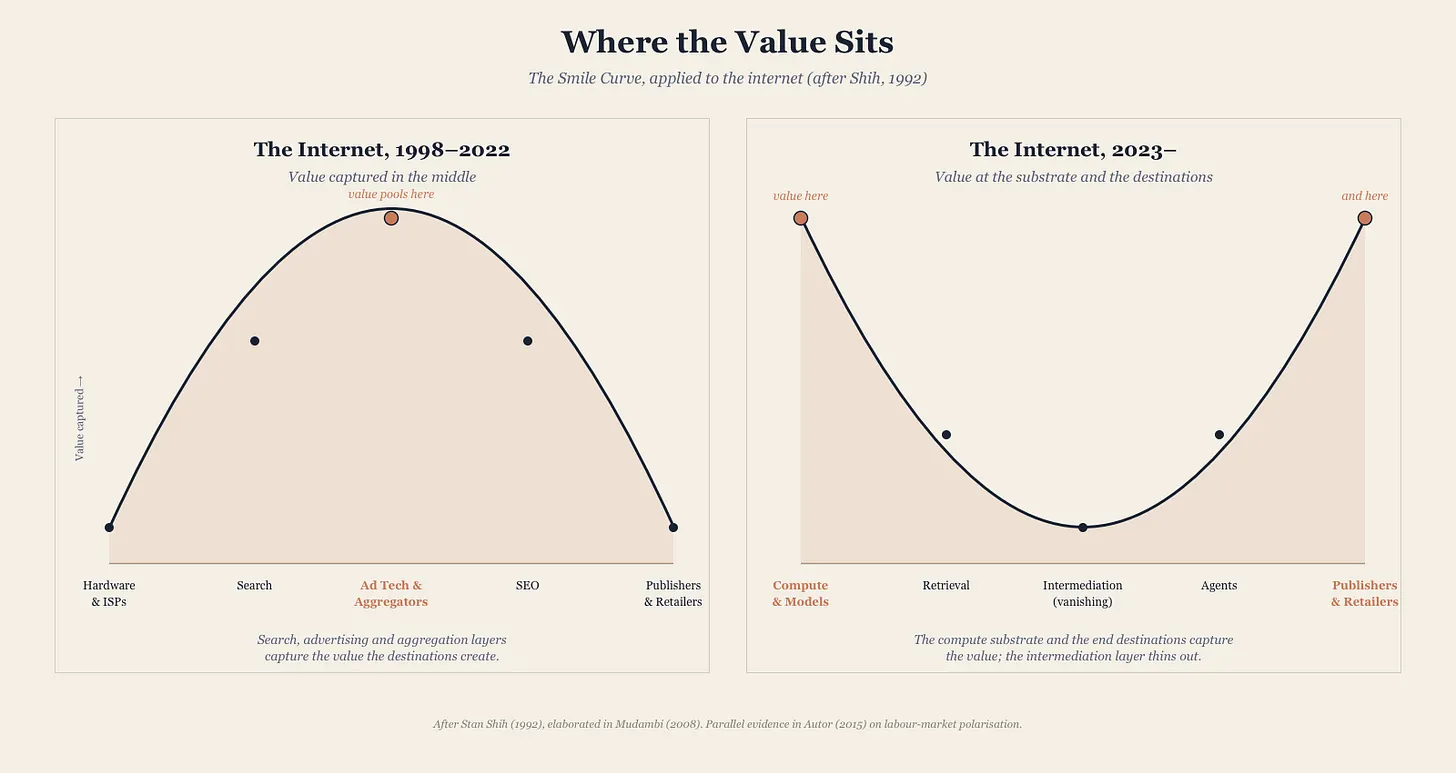
Access to these networks will be paid and gated. LLMs that want to provide accurate answers in specialised domains will need to license content from these hubs, because that’s where the verified, expert-curated, trustworthy information will live.
In many ways, this looks a lot like what “old media” used to look like, where media conglomerates owned publishing expertise across specific knowledge verticals. But compounded into something much bigger, and with a new distribution layer on top.
Full Circle
I admit there’s something a little ironic about this trajectory. Thirty years ago, the internet promised to democratise information and disrupt the gatekeepers. And it did, for a while. But the absence of gatekeeping created its own problems, and now we find ourselves reinventing the institutions we once celebrated dismantling.
Perhaps that’s not such a bad thing. The old gatekeepers had their flaws, to be sure. But at least they were accountable for what they published. The new gatekeepers, the vertical knowledge hubs and the LLMs that depend on them, will be accountable too. Not to advertisers or algorithms, but to users who demand accurate answers.
Is this less Punk Rock than the wild, decentralised internet of the early days? Probably. But as I said in Part 1, I'm not seventeen anymore either.
I’ve written before about content as infrastructure, and I think it’s worth ending with that reminder: the AI economy, as it stands today, runs on three critical inputs: compute (processors), power (energy), and content (data). Look at the stock market and you’ll see that investors have figured out the first two. But content? Content is still valued at nearly nothing, and given the state of content on the internet, it isn’t entirely surprising that it’s being treated as such. But this won’t last.
The re-emergence of quality and curation that I’ve described in this essay, coupled with technology that will enable attributable access to it will, I believe, establish content as the third pillar of AI infrastructure, valued and compensated accordingly. The economics of content will catch up to the economics of chips and kilowatts, and Wall Street will figure this out eventually.
Maybe time to go ‘long’ on a few Publishing stocks…
Hanan